
Ranked: Pre-Sale Home Projects From ‘Money Printer’ to ‘Money Pit’
When selling your house, you need to be selective about pre-sale renovation plans. It’s easy to convince yourself that spending thousands of dollars before listing is a good investment. However, the smartest upgrades are often small. Your goal should be to improve first impressions and make the property look like a home that has been cared for.
It helps to understand what makes a pre-sale home project worth the investment — and what turns one into a money pit.

The Psychology of Pre-Sale Renovations
After years of living with a scratched front door, faded paint, dated cabinet pulls or a bathroom fixture you’ve always intended to replace, listing the house suddenly makes every imperfection feel urgent.
However, sellers and buyers see renovations differently. You may look at a $30,000 kitchen renovation and see $30,000 of craftsmanship, materials and effort. A buyer may simply see a nice kitchen and compare it to another house with an equally attractive one, without knowing or caring what you spent.
That’s why the best pre-sale projects tend to have these three characteristics:
- They are highly visible.
- They make the home feel cleaner, newer or better maintained.
- They cost relatively little compared with the potential improvement in buyer perception.
In other words, perceived value can matter more than construction cost. A fresh coat of exterior paint can transform listing photos and the first few seconds of an in-person showing. Fixing a dripping faucet eliminates a tiny but distracting signal that the house may have maintenance problems. The best part is that none of these projects requires a demolition crew.
Before you spend serious money, consider whether the improvement will make a buyer more likely to choose your house over other properties. If the answer is yes, it may be worth doing. If the answer is no, you may be renovating for yourself rather than for the next owner.
Assessing Your Local Market Before Swinging a Hammer
Determine how much competition your property faces. In a seller’s market, buyers may be willing to overlook dated finishes to secure a home. You are better off doing basic maintenance, cleaning thoroughly and getting the property on the market while demand is strong.
On the other hand, when there are plenty of houses available, presentation becomes a competitive advantage. If the house down the street has fresh paint and a clean, updated-looking kitchen while yours has peeling trim and a leaking faucet, those relatively small deficiencies can become reasons for buyers to choose the other property.
Ask a real estate professional which homes are selling quickly, which ones are sitting and what features buyers are consistently mentioning. You can also try walking through your property as if you were seeing it for the first time. Does the garage door look worn? Are the cabinets visually unappealing? Those are opportunities. Once you’ve established what your market expects, you can start ranking projects by likely return.
High-ROI Pre-Sale Home Projects
Buyers generally want a home that feels clean, maintained, functional and easy to picture themselves living in. The best pre-sale projects are often the least glamorous. However, they work because they improve the home’s visual appeal, reduce visible maintenance concerns and photograph well.
-
Revamping Your Exterior Paint and Curb Appeal
If you’re looking for the best bang for your buck, start outside. A fresh coat of paint on your exterior can make your home look especially cared for. Peeling, faded or mismatched paint can make a structurally sound home feel neglected.
Many real estate professionals and experts consider good exterior paint the single most cost-effective improvement to make before selling. Be strategic in the area you’ll tackle. If the siding is in good condition but the trim looks tired, painting the trim may be enough. If the front door is faded, repainting or replacing it can provide a powerful visual reset.
-
Upgrading Your Garage Door
A garage door often occupies a huge portion of the home’s visible front facade. Replacing an old, dented or unattractive door can dramatically change its appearance. Moreover, standard replacements are often completed in less than a day, helping you list your home sooner.
That matters when you’re working backward from a listing date. A three-week renovation can eat into your marketing schedule. A project that can be completed in a day or so is much easier to fit into the final preparation window.
-
Targeting Small Cosmetic Fixes
Never underestimate the power of small issues. A guest might encounter a leaky faucet and think the rest of the house is poorly maintained.
Start with the obvious:
- Fix leaking faucets and running toilets.
- Replace broken or mismatched light fixtures.
- Tighten cabinet hardware.
- Repair sticking doors and drawers.
- Recaulk visibly deteriorated areas.
- Touch up scuffed walls and trim.
- Replace cracked outlet and switch covers.
- Repair loose railings.
These aren’t exciting renovations. That’s precisely why they’re so valuable.
Projects That Turn Into Money Pits
These renovation plans may look spectacular, but they are poor choices when the goal is to sell soon and maximize the amount of money you walk away with.
1. Adding an Accessory Dwelling Unit
Accessory Dwelling Units (ADUs) and multigenerational spaces are understandable investments from a lifestyle perspective. Housing costs have encouraged more families to live together. Additionally, there is a demand for flexible living arrangements. In fact, 25% of young adults aged 25 to 34 live in a multigenerational household.
However, building extra living space right before selling is a very different thing from enjoying that space for a decade. Large room additions and accessory dwelling units can require architectural plans, engineering, permits, foundation work, plumbing, electrical upgrades, insulation, windows, doors, HVAC and extensive interior finishing. Besides construction costs, you also need to consider the design, permits, project management and delays.
If you’re building an addition because you want to enjoy it for the next 10 years, go ahead and make the decision based on your lifestyle. However, if you’re building it because you’re listing in three months, it might not be a worthwhile project.
2. Undertaking Full Gut Remodels
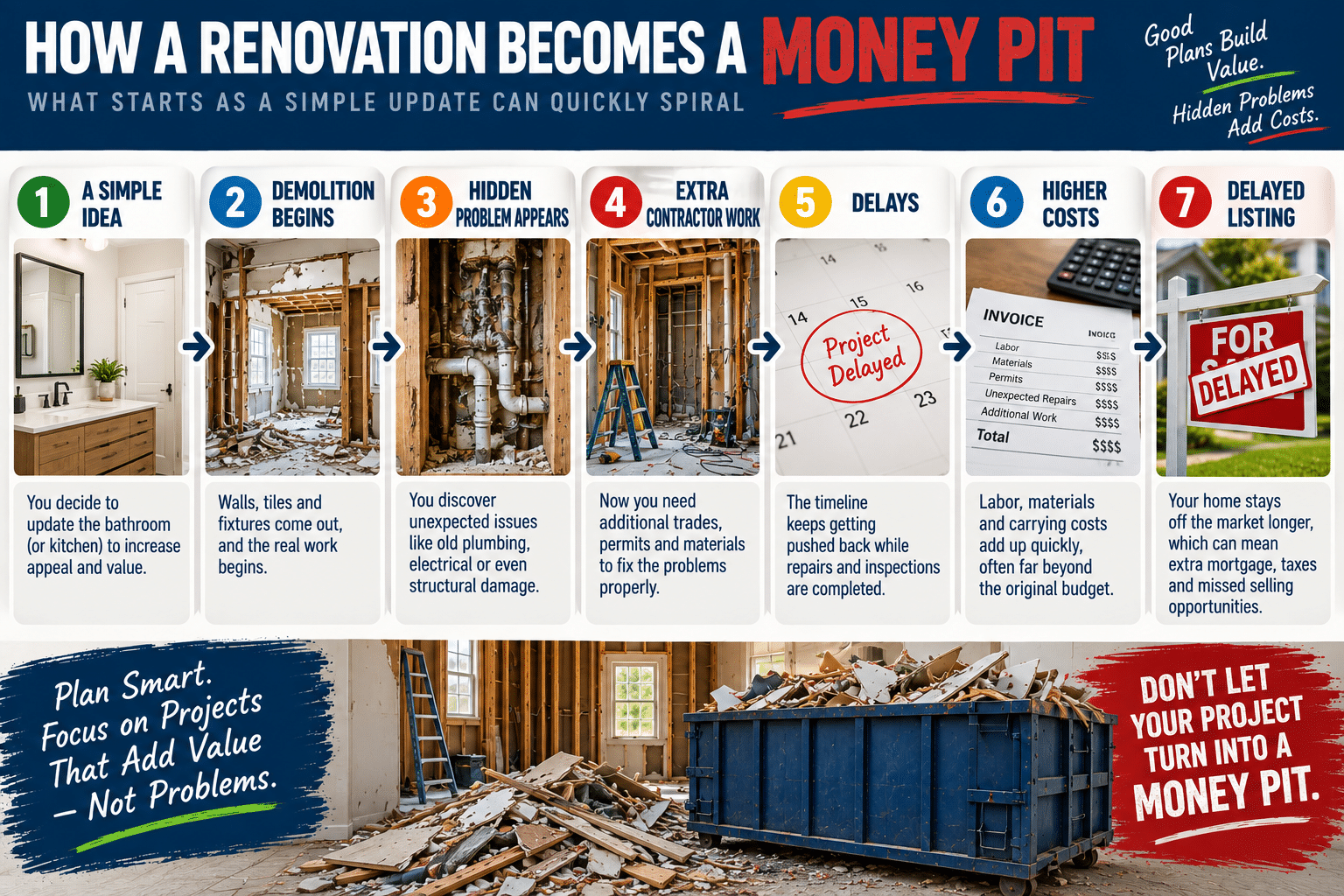
A full gut remodel is the ultimate pre-sale gamble. Walls come down, revealing unexpected plumbing, electrical systems needing upgrades and shaky structural conditions. Your listing date could be pushed further and further back due to construction delays. In a 2025 study on residential buildings in Chennai, India, significant contributors to cost overruns included schedule delays, unforeseen rework, inadequately skilled labor and specification problems.
A delayed project also means additional mortgage payments, utilities, insurance, storage costs and missed opportunities to list during a favorable market window. This is why a pre-sale renovation should have a hard stop. A full remodel can make sense if the property is severely damaged and uncompetitive. However, if the property is in relatively good shape and the project cannot realistically be completed before your intended listing date, renovation probably shouldn’t be started.
3. The Hidden Dangers of DIYing Big Projects
There’s one more way a supposedly high-ROI renovation can become a financial disaster. It is when you decide to do technical or dangerous work simply to save money. DIY is excellent for many cosmetic projects like painting a room, replacing cabinet hardware, decluttering, cleaning and handling simple maintenance tasks. These are all reasonable ways to reduce costs.
However, roofing, major electrical work, structural modifications and other highly technical jobs are different. They can cause injury, property damage, code violations and liability. The National Safety Council estimates work injuries cost $181.4 billion in 2024, including wage and productivity losses, medical expenses, administrative costs and uninsured employer costs. That figure shows the broader economic stakes associated with unsafe work.
A pre-sale renovation is supposed to increase your sale proceeds. Getting injured while attempting a job outside your skill level does the opposite. Outsource any work where a mistake could endanger you, damage the property or create a resale problem. Ensure you hire licensed and qualified professionals for roofing, structural changes, complex electrical work, gas systems, major plumbing and other high-risk jobs. Also, verify contractors carry insurance.
Protect Your Pre-Sale Budget and Timeline
One of the biggest mistakes sellers make is failing to establish a renovation budget and a stopping point before the work begins. They should spend money where buyers can see it or feel it. This means focusing on curb appeal, exterior paint, the garage door, cleaning, decluttering, minor repairs and strategic cosmetic updates.
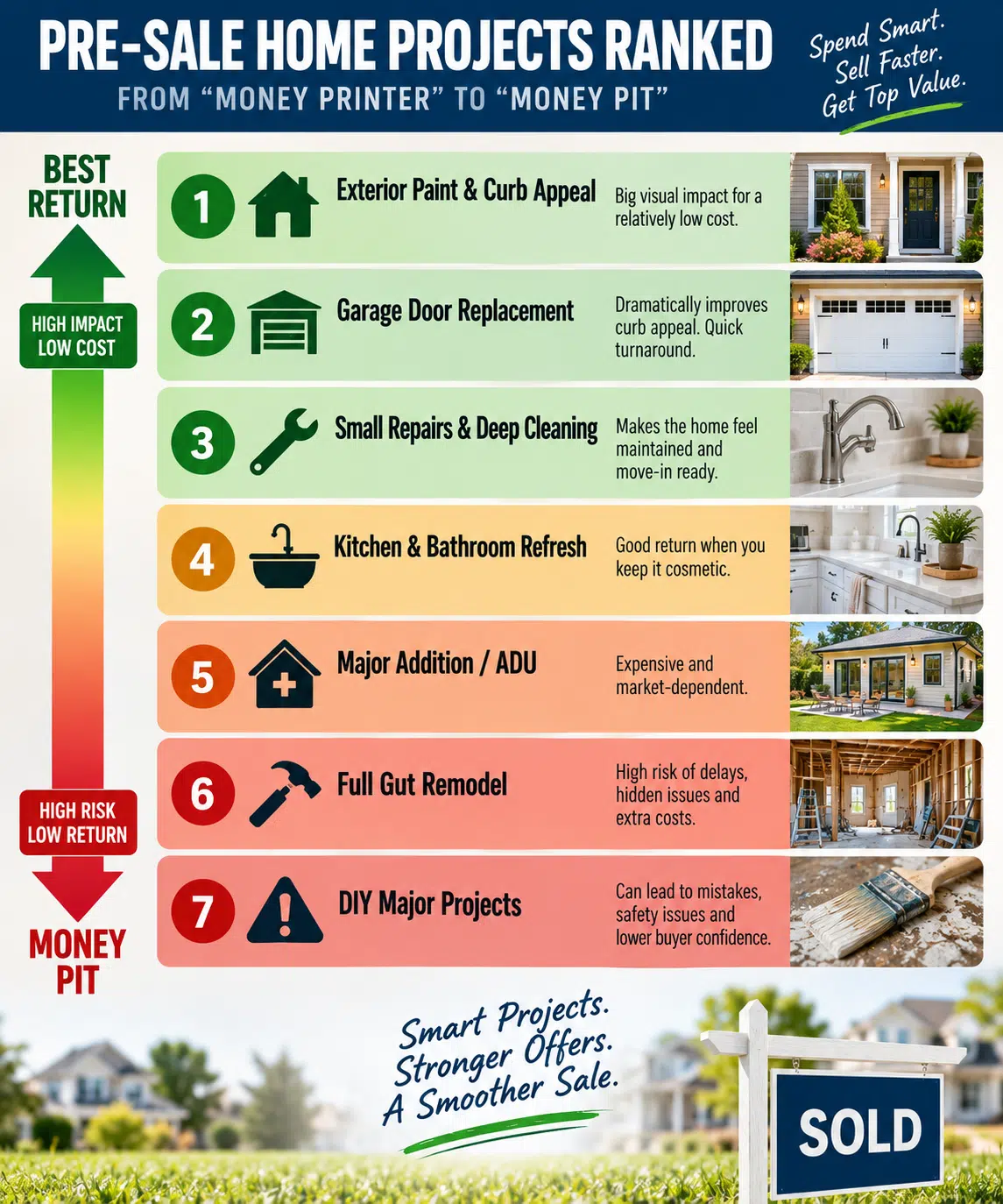
The ranking looks like this:
- Exterior paint and curb appeal
- Garage door replacement
- Small cosmetic repairs and deep cleaning
- Kitchen and bathroom refreshes
- Major additions and ADUs
- Full gut remodels
- DIYing big projects
Ensuring a Successful Pre-sale Renovation
A successful pre-sale renovation makes the next buyer feel they could move into the home immediately. Before approving a project, calculate the time it will take, the possibility of delays, the disruption to your household, the costs if the listing is postponed and the likelihood that the return is higher than your investment. Make sure to prioritize the work that yields the greatest visible improvement at the lowest cost.
Finally, remember that every renovation creates some amount of mess. Cleanup becomes the last obstacle between your renovation and your listing. If you’re tackling a smart round of pre-sale improvements, rent a dumpster to keep the project moving, clear out renovation waste efficiently and get the property ready for showings and buyers.